Education Poster and School Poster Fraction: A Strategic Tool for Visual Learning
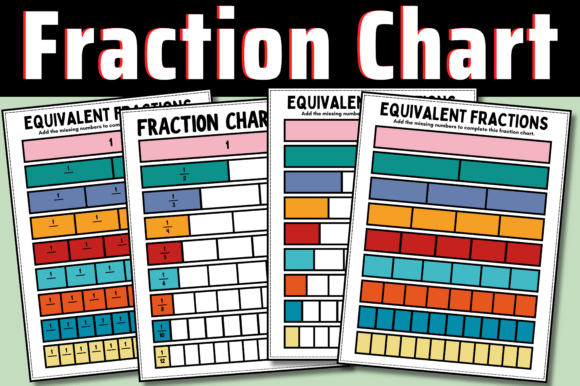
In the landscape of educational resource management, the decision to integrate visual aids is rarely just about aesthetics; it is a strategic choice regarding how information is processed, retained, and applied. The Education Poster and School Poster Fraction set represents a critical intervention point for educators aiming to bridge the gap between abstract mathematical concepts and concrete understanding. These printable fraction strips are not merely decorative classroom elements; they are functional manipulatives designed to make learning fractions interactive and engaging. By simply printing, cutting, and deploying these fraction bar manipulatives, instructors can transform passive observation into active discovery.
The strategic value of these resources lies in their versatility across different instructional models. Whether utilized for whole-class instruction, small group differentiation, special education support, or targeted intervention, the School Poster Fraction system provides a consistent visual language that helps students explore and visually compare how different fractions relate in size. For the professional educator or the homeschooling parent acting as a curriculum director, this tool offers a low-cost, high-impact method to enhance cognitive load management during complex math lessons.
The Strategic Necessity of Tactile Support in Mathematics
Mathematics, particularly at the foundational level, often suffers from an over-reliance on symbolic representation before conceptual mastery is achieved. Students frequently memorize algorithms without understanding the underlying magnitude of numbers. This is where the Education Poster concept becomes operationally vital. The specific design of these fraction strips addresses a common pedagogical failure: the lack of tactile support. When I created this fraction strip set, the driving observation was clear—students needed more hands-on practice to understand and compare fractions effectively.
From a decision-making perspective, adopting these tools signals a shift toward evidence-based teaching practices. Research consistently shows that multi-sensory approaches improve retention rates. By providing both color and black-and-white versions, the resource allows for flexibility in budget planning and printing logistics. Color versions serve as immediate visual anchors for quick comparisons, while black-and-white options allow for student customization, coloring activities, and cost-effective mass production for large classes. This dual-format approach ensures that the School Poster Fraction remains accessible regardless of institutional constraints.
Operational Efficiency in Lesson Planning
Time is the most scarce resource for any educator. The "print, cut, and use" nature of these fraction bar manipulatives streamlines the preparation phase of lesson planning. Unlike digital simulations that require device charging, software licensing, or internet connectivity, physical manipulatives offer immediate availability. This reliability is crucial for maintaining instructional flow. When a teacher can instantly deploy fraction strips to clarify a misconception during a live discussion, the momentum of the lesson is preserved.
Furthermore, the inclusion of fraction anchor charts adds another layer of operational efficiency. These charts serve as easy notebook references, allowing students to internalize the visual relationships between fractions over time. Instead of constantly returning to the whiteboard for clarification, students have a personal reference point. This autonomy supports the development of independent problem-solving skills, a key metric in long-term educational outcomes.
Aligning Resources with Instructional Goals
To maximize the return on investment for these materials, one must align their usage with specific learning objectives. The School Poster Fraction set is most effective when used intentionally rather than randomly. Random distribution of worksheets or posters often leads to clutter and cognitive overload. Strategic deployment involves identifying exactly which fraction concepts require reinforcement—such as equivalence, comparison, or addition—and selecting the appropriate manipulative configuration to address those needs.
For example, in a small group setting focused on special education, the focus might be on matching physical strips to numerical representations to build confidence. In contrast, a whole-class instruction scenario might utilize the larger poster versions to facilitate a guided inquiry where students predict the sum of two fractions before verifying with the strips. This adaptability ensures that the Education Poster serves diverse learner profiles within the same ecosystem.
- Whole-Class Instruction: Use large-scale prints to demonstrate general principles and establish a shared visual vocabulary.
- Small Groups: Distribute individual sets for collaborative problem-solving and peer-to-peer explanation.
- Targeted Intervention: Isolate specific skill gaps using the strips for one-on-one remediation, focusing on magnitude and equivalence.
- Notebook Integration: Utilize the anchor charts as permanent reference tools to reinforce daily learning.
Enhancing Communication and Branding in Educational Spaces
Beyond the immediate academic utility, the visual consistency of a well-planned classroom environment contributes to the overall "brand" of the learning space. A cohesive Education Poster strategy creates a professional atmosphere that communicates organization and intentionality to students, parents, and administrators. When a classroom is populated with purposeful, high-quality visuals like these fraction strips, it signals a commitment to rigorous, thoughtful pedagogy.
For entrepreneurs and creators selling educational materials, understanding the end-user's need for such clarity is essential. The market demands resources that solve specific problems efficiently. The success of this fraction strip set stems from its ability to solve the tangible problem of abstract confusion through concrete visualization. It demonstrates that effective educational products do not need to be overly complex; they need to be strategically aligned with the cognitive processes of the learner.
Risks of Misapplication and Contextual Considerations
While the benefits of the School Poster Fraction are significant, there are risks associated with using them without clear goals or context. One potential pitfall is treating the manipulatives as a substitute for direct instruction rather than a supplement. If students are handed fraction strips without guidance on how to interpret the visual data, the activity may become busy work rather than meaningful learning. The tool is only as effective as the facilitation surrounding it.
Another consideration is the potential for dependency. If students rely exclusively on the physical strips to perform calculations, they may struggle to transition to mental math or symbolic manipulation later on. The strategic approach requires a phased implementation: starting with heavy reliance on the Education Poster and manipulatives, gradually fading the support as conceptual understanding solidifies. This scaffolding technique ensures that the visual aid serves as a bridge to independence, not a crutch.
Decision-Making Framework for Implementation
Before integrating these resources, educators should ask several critical questions to ensure alignment with their broader curriculum goals:
- What specific fraction concept is causing confusion in my current cohort?
- Do my students benefit more from color-coded distinctions or monochromatic simplicity?
- How will I structure the activity to ensure active engagement rather than passive observation?
- Is this resource part of a long-term plan to build number sense, or a temporary fix for a single lesson?
Answering these questions transforms the purchase or creation of an Education Poster from a reactive measure into a proactive strategy. It ensures that every printed sheet and cut strip serves a defined purpose in the journey toward mathematical proficiency.
Long-Term Value and Continuous Improvement
The true measure of success for any educational tool is its impact on long-term results. The School Poster Fraction set is designed to foster deep conceptual understanding, which translates to better performance in higher-level mathematics. Students who grasp the visual relationship between fractions early on are better equipped to handle algebraic ratios, proportional reasoning, and calculus concepts later in their academic careers.
Moreover, the iterative nature of using these materials allows for continuous improvement. Teachers can observe how students interact with the strips, noting which comparisons are intuitive and which require further explanation. This feedback loop informs future lesson planning and resource selection. By following stores and communities dedicated to sharing such resources, educators stay updated on best practices and new variations of these tools, ensuring their methods remain current and effective.
Ultimately, the decision to use the Education Poster and School Poster Fraction is a decision to prioritize clarity, engagement, and strategic depth in the classroom. It is an acknowledgment that learning is a visual and tactile process, and that providing the right tools at the right time can significantly alter the trajectory of a student's mathematical development. For professionals, creators, and educators alike, the focus must remain on intentional application, ensuring that every resource deployed drives measurable progress toward educational excellence.